Silver Surprise
Alan Taffel
Full disclosure: When it comes to cables, I’m not a silver kind of guy. I’ve just never liked the sound—and in my experience, there is a sound—of that metal. To me, silver cables and cords have always come off as cold and analytical. When I’ve had the chance to compare silver and copper cables, all other things being equal, I’ve invariably preferred copper.
So, when Robert Harley approached me with an offer to re-view some new silver cables from the 32-year-old Danish company Argento, I politely begged off. Given my past experience with silver, I explained, such a project would hardly be fair to the manufacturer. But Robert persisted. People whose ears he trust-ed had told him that these were no ordinary silver cables. I agreed to give them a listen, with no commitment to do a full review.
Well, the fact that you are reading this gives away the punch-line. I tried the Argento Flow Ultima cables and power cords, and I liked them. I really liked them. In fact, I preferred them to my longtime Empirical Design reference cables—and that’s saying a lot.
Preparation
My honeymoon with the Argentos did not begin immediately. In fact, at first I disliked them quite a bit. Compared to the energy and extension of my reference cables, the Flow Ultimas were initially soft, polite, and closed in. The only silver lining, so to speak, was that they didn’t sound like silver. In a bizarre way, that was encouraging.
In speaking with Argento, I learned that their cables re-quire a lot of break-in. I had already submitted them to about 50 hours, but that, they told me, wasn’t enough. The interconnects and speaker wire needed about 100 hours, while the power cords re-quired several times that.
Sure enough, in reasonably short order the interconnects and speaker wire began to flourish. On the other hand, the power cords stubbornly refused to open up. Eventually I ran out of time and patience, at which point I asked Argento to simply send me some broken-in power cords. They complied, and when I put them in my system the difference was immediate and dramatic. The sound I’ll describe below applies to the broken-in interconnects, speaker cable, and power cords. They all have the same sonic imprint, so there’s no need to describe them separately.
Once broken in, the sound of the Argento Flow Ultimas not only excelled but came as a complete surprise to me. They did not sound like any silver cable I’d ever heard. Rather than sounding cold, they were as warm as my copper references. Nor were they the slightest bit analytical. Instead, the Flow Ultimas delivered the same organic musicality as my references. This would have been news enough for me, but the fact is that the Flow Ultimas go well beyond upending expectations about silver. They are simply superior cables and in a multitude of ways.
The greatest asset of the Flow Ultimas is an uncanny level of resolution. They achieve this not by etching details, but rather by affording the signal an unobstructed path—no connections, no material or impedance changes, minimized crystalline defects—through the cable. (How did they do that? Please see the sidebar. )
In this way, the Argentos can deliver resolution without the usually attendant exaggerated detail.
You can hear this resolution easily in the way the Argentos handle decays and reverb. Listen, for example, to the percussion on the opening of London Grammar’s “Hey Now.” The decays ebbed and ebbed for far longer than I’m used to. And on Neil Young’s peerless Live at Massey Hall, 1971, the hall reverb was far more evident than it is without the Argentos in the system.
The latter recording revealed another area of the Flow Ultima’s superiority: dimensionality. Through these cables, both the acoustic guitar and Neil’s voice took on a 3-D character I’d not previously heard on this LP. On orchestral recordings, the soundstage itself also became more 3-D, with significantly great-er depth. In addition to this resolution in the spatial domain, the Flow Ultimas also better resolved timbres, making it easier to hear the difference between instruments.
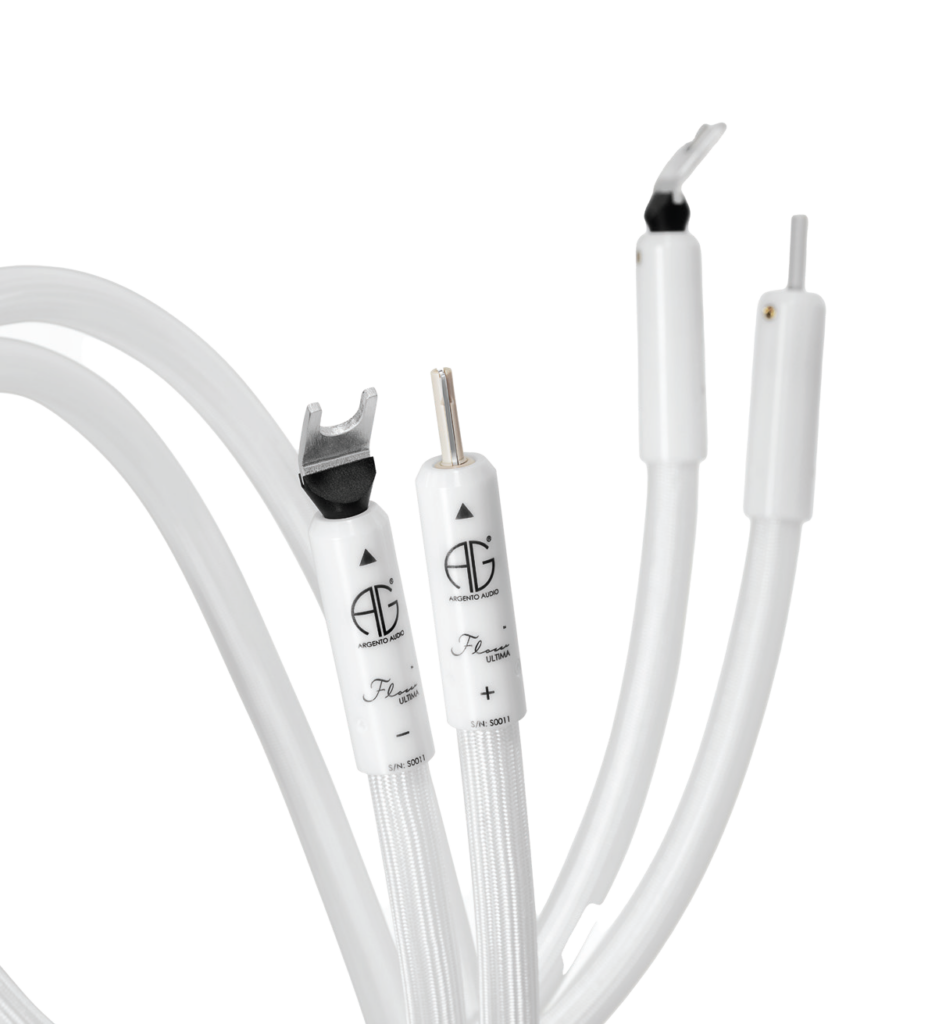
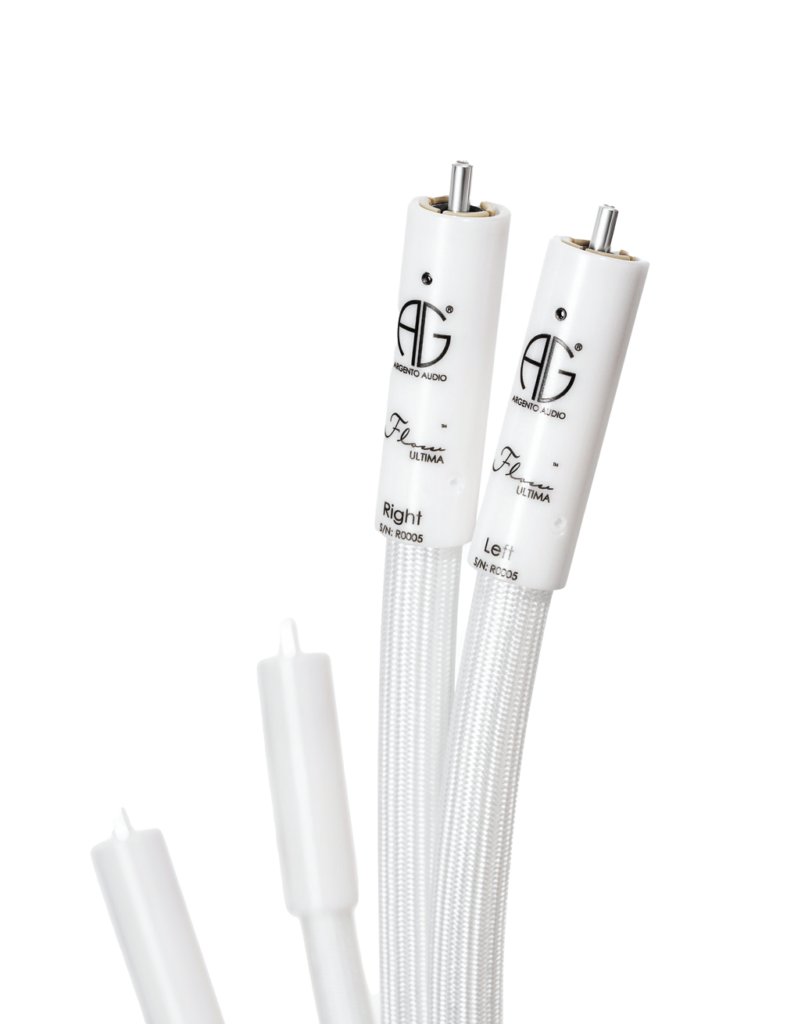
At this price point, a cable’s ergonomics should be as excellent as its sound quality. This brings up another admirable quality of the Flow Ultima cables, and one that is far from universal within high-end cables: They’re easy to work with. The Argentos aren’t overly stiff, and their terminations are robust. I must say that I also appreciated the beautiful leather cases that enshroud the cables when they’re delivered. The user experience here is as elevated as you could ask for.
Another area where the Argentos distinguished themselves—even beyond the already superb capabilities of my reference cables—was in transients. Bass, for example, took a leap in tautness. On a really dynamic track like “Los” by Rammstein, the Argento cables served up a formidable “pow” on the drums.
Which brings us to the matter of price. There is no question that the Flow Ultima cables are expensive. However, if you pe-ruse the cable terrain, you’ll see that they are nowhere near the outrageous end of the spectrum; they’re more in the middle. Further, the Flow Ultimas contain a lot of pure silver—no alloy conductors or non-silver terminations here—and silver is expensive.
With the Flow Ultima, you are getting what you pay for.
For anyone who has internalized a concept of how silver cables sound, the Argento Flow Ultima will come as a surprise. They sound nothing like typical silver cables. They are warm, resolved, dynamic, dimensional, articulate, and highly musical.
Yet these are not simply better silver cables; they’re better cables altogether. The Flow Ultima outperformed what I’ve come to feel are the best copper cable out there. I’m backing that up by making the first change in my reference cables in well over a decade. The Flow Ultimas are my new references.
| Specs and Pricing |
| MUSICAL ARTISANS (U.S. Distributor) 4826 Main St. Skokie, IL (847) 877-2791 rreyes@musicalartisans.com musicalartisans.com Prices: 1m interconnect, $6850; 1.2m phono cable, $7750; 1m speaker cable, $10,250; 2m power cord, $6850 Associated Equipment Analog source: Lyra Etna Lambda Edition cartridge, Goldmund Studietto turntable, Graham 2.2 tonearm Digital source: Bryston BCD-3 CD player Electronics: CH Precision I1 integrated amplifier (phonostage, DAC, streamer, linestage, power amplifier), Goldmund Telos 800 stereo power amp Speaker: Wilson Audio Sasha V, Estelon Forza Cables and cords (except Ethernet): Empirical Design Network switch: Reiki Audio Ethernet cable: Reiki Audio |
The Argento Extreme Edition
AS SOPHISTICATED AS the Flow Ultima
is, it’s not Argento’s range-topper. That
would be the Extreme Edition Series. Whereas
the Flow Ultima’s single-conductor per polarity
construction is a departure for Argento, the
EE cables can be thought of as the company’s
standard multi-conductor design on steroids.
For instance, the EE interconnects have over
a hundred conductors, and the speaker cable
contains 1.7 miles of wire.
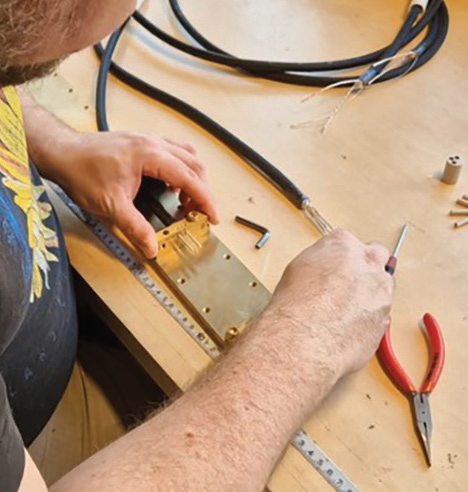
With so much raw silver, it’s no wonder that
the EE cables weigh a ton and cost four times
the price of the Flow Ultima. At that price, they should sound better. But do they?
I had the opportunity to find out when I visited Euphoria Audio, a high-end dealer in Dallas. Along with Argento cables, Euphoria carries all kinds of audio goodies, like the latest Soulution electronics and a range of Stenheim speakers. When I was there,
the top system on the floor consisted of said
Soulution electronics, a Taiko Olympus music
server, the impressive (and new to me) Kroma
Atelier Turandot speakers ($318k), and the Argento EE cables.
Comparing the Extreme Edition with the Flow Ultima was a simple matter of swapping. Did the Extreme Editions sound better? Yes. And clearly so. The Flow Ultima couldn’t quite match the EE in terms of top-end openness and the speed of transients. On the other hand, both had the same dynamics and bass authority, and the less expensive cable was every bit as resolved as its more expensive sibling.
I’m not sure how apparent these differences would be without the benefit of a direct A/B comparison. However, based on what I heard, if I had the means, I’d definitely opt for the Extreme Edition cables, despite their costing a small fortune. They’re that good.
How Did They Do It?
IF YOU’RE LIKE me, with an inquiring—though not always fully astute—mind, you hear something like the Flow Ultima and wonder how Argento managed to break the silver-cable paradigm. To understand that, I spoke with Ulrik Madsen, the founder, CEO, owner, and chief designer of Argento. I haven’t studied physics like he has, but I think I got the gist of what he told me. Be it known that Ulrik is a die-hard silver evangelist. Yet he agrees that most silver cables sound lousy. The reason, he says, is that “most of them do not actually contain much silver.” He elaborates, “Silver is expensive, so manufacturers take shortcuts like using alloy conductors or brass terminators to keep costs down.” With such cables, he says, you’re not really hearing the full potential of silver.

But there are plenty of expensive silver cables out
there that don’t take such shortcuts. How come they don’t sound like the Argentos? The difference, according to Ulrik, is in the way the silver is treated. Usually, in silver cables, the goal is to create
one long crystal for each conductor that spans the
length of the cable (excluding terminators).
That goal is admirable, says Ulrik, because “it is silver’s ability to form long crystal strands that accounts for its sonic superiority over copper.”
Unfortunately, he warns, “There are inevitable defects in those strands that arise from the normal manufacturing process, and these defects are audible.” To get around this conundrum—you want long strands without the inevitable unwanted crystalline defects—Argento takes a novel approach. They increase the size of the single crystal. This process is called vacuum recrystallization, and it’s done by mildly
heating the conductor in a vacuum. The result is “our conductors contain as large a crystal as possible after vacuum recrystallization.
Any piece of silver that starts out as a single crystal will not be that once the silver is drawn out into a conductor.” Argento also pays unusual attention to the mechanical side of its designs, the goal being to eliminate resonances within the cable. The company conducted an extensive search for a dielectric material that not only did its job well but also had low resonance. Eventually, Argento hit on the idea of an injected mass. That substance is called VDM, for Vibration Damping Material. Ulrik claims
that the use of VDM minimizes mechanical resonances, and, additionally, the VDM material becomes the dielectric once it is injected into the cable. In another departure from cable norms, Argento avoids all magnetic parts in its power cords. That means no steel or iron, so screws are made of either ceramics or titanium. The conductors
and blades are, of course, pure silver.
Argento takes the above steps in all its silver cables, including the Flow Ultima. However, in one key way, the Flow Ultima diverges radically from its brothers: It eschews the company’s usual practice of employing multiple conductors per polarity. Instead, the strategy with the Flow Ultima Interconnects is to form a single large conductor per polarity
from one end of the cable—including terminators—to the other, with no electrical or mechanical breaks.
This approach, says Ulrik, “allows the possibility to have no standard terminator whatsoever on the cable. The terminator merely holds the end
of the conductor in place.” In other words, unlike virtually all other cable terminators, the Flow Ultima terminator has no breaks, no connections,
no changes in metal, and no variation in thickness between the conductor and the terminator.
Ulrik claims several benefits to this approach. First, the signal sees only one path, which, as mentioned in the review, permits resolution without edge or loss of musicality. Next, it lowers capacitance.
The technique also eliminates variations in impedance that typically arise when different thicknesses of metal are joined. Obviously, a single-conductor cable is also less expensive to build
than multi-conductor cables. (The Flow Ultima line is about one fourth the cost of the higher Extreme Edition line.) Finally, from a musical perspective, Ulrik hears “a level of intimacy and performance
that wouldn’t otherwise be possible.” My listening bears that out.